The Ultimate Guide to Digital Marketing in the AI Era: 30 Questions Answered With Real Data
By Ravinder Cheema, Clicks Dynasty · Published September 30, 2026 · About 20 minutes to read
For twenty years, digital marketing had one front door: a search box, ten blue links, and a customer who clicked. That door is closing.
Today, a homeowner with a leaking water heater asks Google and gets an AI-written answer before a single website loads. A founder asks ChatGPT which CRM to buy. A patient asks her phone for the best-reviewed dentist within five miles. In each case, a machine reads the web, decides who is trustworthy, and hands over a short list. Most people never click past it.
This guide is the playbook for that new reality. It is built for four readers at once: the beginner learning the craft, the online business watching traffic get more expensive, the local service pro who needs the phone to ring, and the industry veteran whose job description is being rewritten in real time. Every major claim is backed by a number. Where a number doesn't exist, we say so.
The AI-era marketing landscape by the numbers
Contents
1. Executive summary: what changed and what it means for you
Search has changed more in the last two years than in the previous ten. Three shifts explain almost everything.
Shift one: the answer arrives before the click. Advanced Web Ranking found AI Overviews on 43% of sampled desktop results pages in mid-2026. On those pages, the click-through rate for the #1 organic result fell from 20.02% to 9.69%, and 74.3% of searches ended with no click at all, compared with 53.6% on pages without an Overview. Seer Interactive measured a 61% drop in organic click-through and a 68% drop in paid click-through on queries where Overviews appeared.
When an AI summary appears, clicks get cut nearly in half
Share of Google visits that ended in a click, Pew Research Center browsing study of U.S. adults, 2025
Shift two: the audience moved into chat. ChatGPT reached 900 million weekly active users in February 2026. Google says AI Overviews reach more than 2 billion people a month. Back in 2024, Gartner predicted traditional search engine volume would fall 25% by 2026 as people shifted to AI assistants. Whether or not that exact number lands, the direction is not in doubt.
Shift three: production became nearly free. One person with AI tools can now write, design, edit video and launch campaigns at a pace that once required a team. The consequence is a flood. When everyone can publish 100 articles a month, the 101st generic article is worth close to nothing.
Here is what those shifts mean for each type of reader:
- Beginners: The barrier to entry has never been lower, and the bar for "average" has never been higher. AI makes mediocre work instant, so fundamentals (intent, measurement, offer, copy) are what separate you.
- Online businesses: Traffic is harder to buy and harder to earn. The upside: Semrush's 2025 research found the average visitor arriving from AI search was worth 4.4 times a traditional organic visitor, because they show up pre-qualified. Owned audiences (email, SMS, community) are your insurance policy.
- Local service businesses: You hold an unfair advantage. AI can't fix a roof, clean teeth or file a tax return. Real reviews, real photos and real proof beat any content farm, and the data on reviews (below) has never been stronger.
- Industry pros: The job is shifting from producing content to directing, verifying and differentiating it. Your value is judgment, not word count.
The one-line rule: AI makes content cheap. Trust, proof and first-hand experience are now what get chosen, by customers and by the machines that recommend you to them.
2. The five core pillars, rebuilt for AI
The channels haven't changed. What wins inside each one has.
Pillar 1: SEO (Search Engine Optimization)
SEO used to mean ranking. It now means being found and being cited: in Google results, AI Overviews, Maps, and chat assistants like ChatGPT, Gemini and Perplexity.
- Local: Your Google Business Profile is your #1 asset. Google's own data shows customers are 2.7 times more likely to consider a business reputable when its profile is complete, and 70% more likely to visit. Complete every field, choose the most accurate primary category, post weekly, and keep reviews flowing. See our local SEO services or run a free check with the SEO & AI checker.
- Online: Build topic clusters around the real questions customers ask. Add schema markup (our free schema generator takes two minutes). Keep pages fast: Google research found the probability of a bounce rises 32% as mobile load time goes from one second to three.
- AI-era add-on: Put a clear, direct answer in the first 40 to 60 words under each question heading. A 2024 study on Generative Engine Optimization from researchers at Princeton, Georgia Tech and IIT Delhi found that adding statistics, quotations and cited sources increased a page's visibility in AI-generated answers by up to 40%.
The payoff for getting cited is measurable. Seer Interactive found that brands cited inside an AI Overview earned 35% more organic clicks and 91% more paid clicks than brands that weren't.
Pillar 2: Content marketing
- Publish what AI can't invent: case studies, before-and-after photos, original data, expert opinions and honest pricing breakdowns. When we tested seven core-update assumptions on our own site, word count didn't decide rankings. Search intent and original data did.
- Use AI for outlines, first drafts and repurposing. Use a human for experience, accuracy and voice.
- Build a content multiplier: one strong piece becomes one blog post, three short videos, five social posts and one email. That's 10 assets from one idea, which is where AI earns its keep.
Pillar 3: Paid advertising (PPC)
- Google and Meta ad platforms now run largely on AI (Performance Max on Google, Advantage+ on Meta). Google has reported that advertisers using Performance Max see 18% more conversions on average at a similar cost per action. The catch: your inputs are the only lever left. Conversion tracking, creative quality and audience signals decide whether the machine finds buyers or burns budget.
- Local: Google Local Services Ads (where available) sit above regular search ads and charge per lead rather than per click.
- Benchmarks to keep you honest: WordStream's 2025 Google Ads data put the cross-industry average at a 6.66% click-through rate, $5.26 cost per click, 7.52% conversion rate and $70.11 cost per lead.
- Never run ads without conversion tracking. Automated bidding optimizes toward whatever you measure. Measure nothing, and it optimizes for nothing. Our Google Ads management team starts every account with a tracking audit for exactly this reason.
Pillar 4: Social media
- Short-form video (Reels, TikTok, YouTube Shorts) drives reach. HubSpot's annual marketing surveys have ranked short-form video as the highest-ROI content format for several years running. LinkedIn, with more than 1 billion members, drives B2B trust.
- Pick one or two platforms where your customers already spend time. Consistency on two channels beats absence on seven.
- Show faces, process and results. Unpolished behind-the-scenes content routinely outperforms stock-style polish, because it is proof, and proof is the scarce resource of the AI era. Need help? See social media management.
Pillar 5: Email marketing
- The only channel you fully own. No algorithm stands between you and your list, and Litmus pegs the average return at $36 for every $1 spent.
- Automation does the heavy lifting. In Klaviyo's e-commerce data, automated flows generated nearly 41% of email revenue from just 5.3% of sends, with click rates of 5.58% versus 1.69% for one-off campaigns.
- Start with a welcome sequence (three to five emails), then a regular newsletter.
- Authenticate your domain with SPF, DKIM and DMARC. Since February 2024, Gmail and Yahoo require it for bulk senders (5,000+ messages a day), along with one-click unsubscribe and a spam complaint rate below 0.3%. Microsoft applied similar rules to Outlook in 2025.
- Local: Use email and SMS for seasonal reminders, review requests and repeat bookings. Explore email marketing automation.
3. The 12-week execution roadmap
Strategy without sequence is a wish list. Here is the order that works, week by week.
Foundation
- Define one ideal customer and the #1 problem you solve for them.
- Fix the website basics: mobile-friendly, loads in under three seconds, a clear offer above the fold, one obvious call to action.
- Install Google Analytics 4 and Google Search Console, and track conversions: calls, forms, bookings and sales. (GA4 setup help)
- Claim and complete Google Business Profile, Bing Places and Apple Business Connect.
- Make your name, address and phone number identical everywhere online.
Visibility
- List the 30 to 50 questions customers actually ask you. Turn them into pages and FAQs with direct answers.
- Launch a review-request system: a text or email with a direct link within 24 hours of every job or order.
- Start one social channel on a three-posts-a-week rhythm.
- Build an email capture offer (checklist, quote, discount) and a welcome sequence.
Acceleration
- Launch a small, tightly targeted paid campaign on your highest-intent keywords.
- Earn local and industry links: chamber listings, supplier pages, sponsorships, guest features and "best of" roundups.
- Repurpose your top-performing content across every active channel.
Optimize
- Review KPIs. Cut what isn't working; double down on what is.
- Refresh your top 10 pages every quarter with new data, photos and answers.
- Test one variable at a time: headline, offer, ad creative or landing page.
4. KPIs and benchmarks that matter
In a zero-click world, clicks are no longer the whole story. Measure visibility, trust and revenue together.
| Goal | KPI | Why it matters | Reference point |
|---|---|---|---|
| Visibility | Impressions, Map Pack rank, AI Overview and assistant mentions | Are you being seen and cited? | AI Overviews appear on ~43% of desktop results (AWR, 2026) |
| Traffic | Organic sessions, branded search volume | Rising branded search means rising trust | Track month over month; aim for steady growth |
| Engagement | Engagement rate, time on page, email click rate | Is the content actually landing? | Email flows: 5.58% click rate; campaigns: 1.69% (Klaviyo) |
| Leads | Calls, form fills, bookings, conversion rate | The number that pays the bills | Google Ads average conversion rate: 7.52% (WordStream, 2025) |
| Efficiency | Cost per lead (CPL), cost per acquisition (CPA) | What each customer costs you | Google Ads average CPL: $70.11 (WordStream, 2025) |
| Profitability | ROAS, lifetime value (LTV), LTV:CAC ratio | Whether marketing makes money | Break-even ROAS = 1 ÷ profit margin; LTV:CAC of 3:1 is a common healthy target |
| Reputation | Review count, average rating, review velocity | Drives local rankings and conversions | 31% of consumers only use 4.5-star+ businesses (BrightLocal, 2026) |
Tip: Track three to five KPIs at first. One dashboard you check every week beats 40 metrics you never read.
5. 3 fast wins and 3 costly mistakes
⚡ 3 fast wins
- Optimize your Google Business Profile today. Categories, services, photos, Q&A and a weekly post. In Whitespark's 2026 Local Search Ranking Factors survey, profile signals such as primary category and business name keywords gained ground, making this the fastest local lift available to most businesses.
- Ask every happy customer for a review, within 24 hours, by text, with a direct link. Review recency jumped from #93 to #11 in Whitespark's ranking factors between 2023 and 2026, and 74% of consumers look for reviews from the last three months.
- Add a direct-answer FAQ to your top five pages. One change helps rankings, AI citations and conversions at the same time.
🚫 3 costly mistakes
- Publishing unedited AI content at scale. Google's March 2024 core update cut low-quality, unoriginal content in search results by 45%. Thin pages don't just fail on their own; they drag down the trust of your whole site.
- Running ads with broken or missing conversion tracking. You'll pay the algorithm to optimize for nothing. Before you spend a dollar, submit a test lead and confirm it records.
- Renting your entire audience. If every customer comes from one platform, one policy change can wipe you out overnight. Every month, move some of that rented attention onto a list you own.
6. The 30 questions: digital marketing in the AI era
Grouped by topic. Each answer leads with the short version, then the evidence.
Fundamentals
1. What is digital marketing, in plain terms?
2. How has AI changed digital marketing?
3. Is digital marketing still worth learning if AI can do it?
4. Where should a complete beginner start?
5. What's the minimum budget to start?
SEO and AI Search
6. Is SEO dead because of AI?
7. What are GEO and AEO?
8. How do I get mentioned in ChatGPT, Gemini or Perplexity answers?
9. What is E-E-A-T and why does it matter now?
10. Do backlinks still matter?
11. How important are reviews for local SEO?
12. Should I optimize for voice search?
Content and AI Tools
13. Can I use AI to write my content?
14. Will Google penalize AI-generated content?
15. What content performs best right now?
16. How often should I publish?
17. What AI tools should a small business actually use?
Paid Advertising
18. Google Ads or Meta Ads?
19. What are Performance Max and Advantage+?
20. Why do my ads get clicks but no leads?
21. What's a good ROAS?
Social Media
22. Which social platform should I focus on?
23. Is organic social still worth it?
24. Should I use AI avatars or AI-generated videos?
Email and Automation
25. Is email marketing still effective?
26. How do I grow an email list from zero?
27. What should I automate first?
Strategy and Measurement
28. How do I measure success when AI answers cause zero-click searches?
29. How long until digital marketing shows results?
30. What skill matters most for marketers in the AI era?
The bottom line
The tools changed. The customer didn't. People still hire the business they trust, and in 2026 trust is built from things a machine can verify but can't fake: real reviews, real results, real people and real data.
Get the foundation right in the next two weeks. Earn visibility over the next six. Accelerate by week twelve. Then measure, cut and compound. Do that, and AI stops being a threat to your traffic and becomes the fastest employee you've ever had.
If you'd like a second set of eyes on where you stand today, request a free quote or explore our AI SEO services.
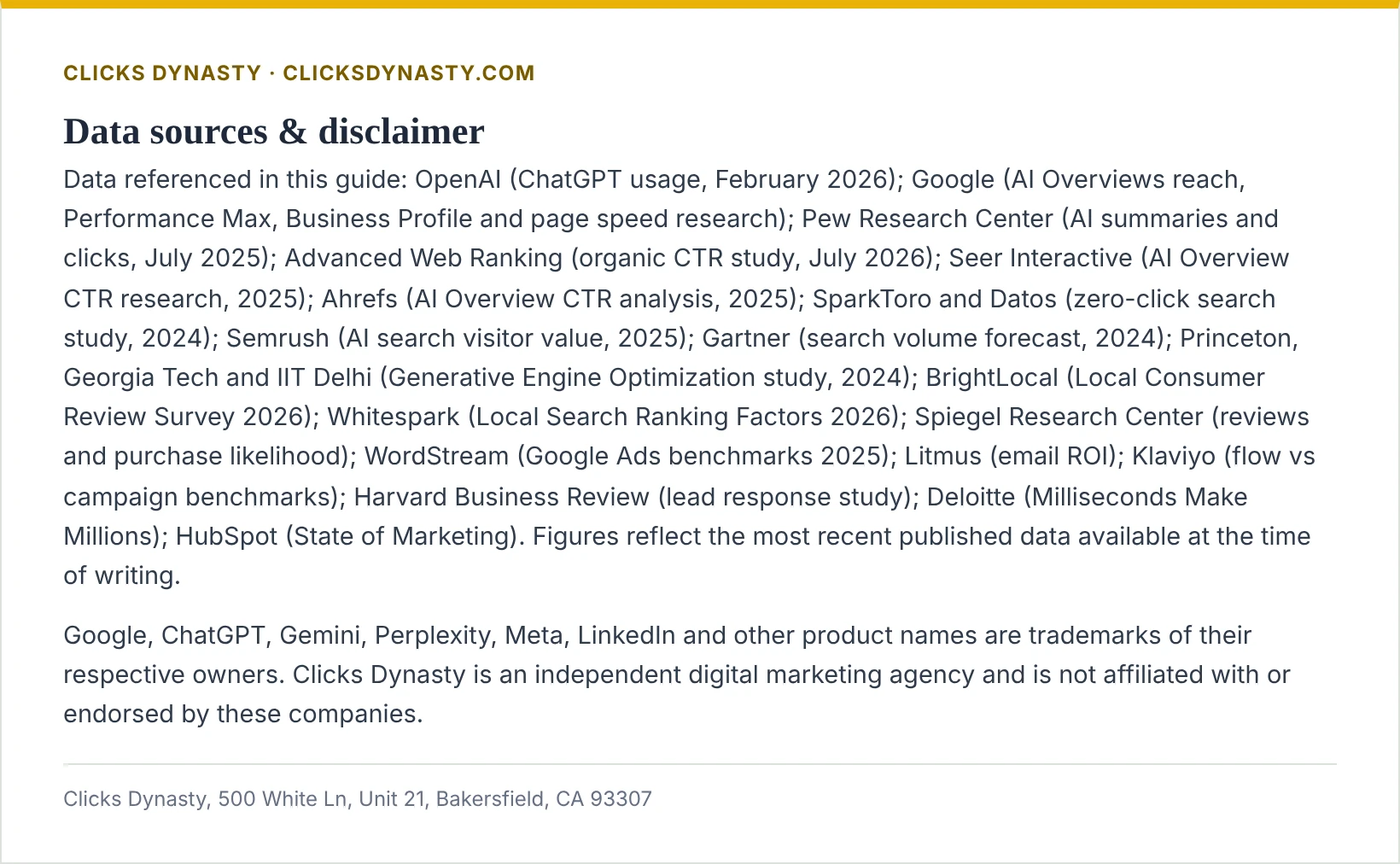
Data sources & disclaimer
 Click the image to open it full size.
Related reading: How to Protect Your Privacy on ChatGPT, Claude, Perplexity and Other AI Apps · Digital Marketing Companies in Bakersfield, CA: 4 Local Firms Compared