Comparing Search Engines in the AI Era: Google vs Bing vs Yahoo vs DuckDuckGo (30 Questions Answered)
By Ravinder Cheema, Clicks Dynasty ·
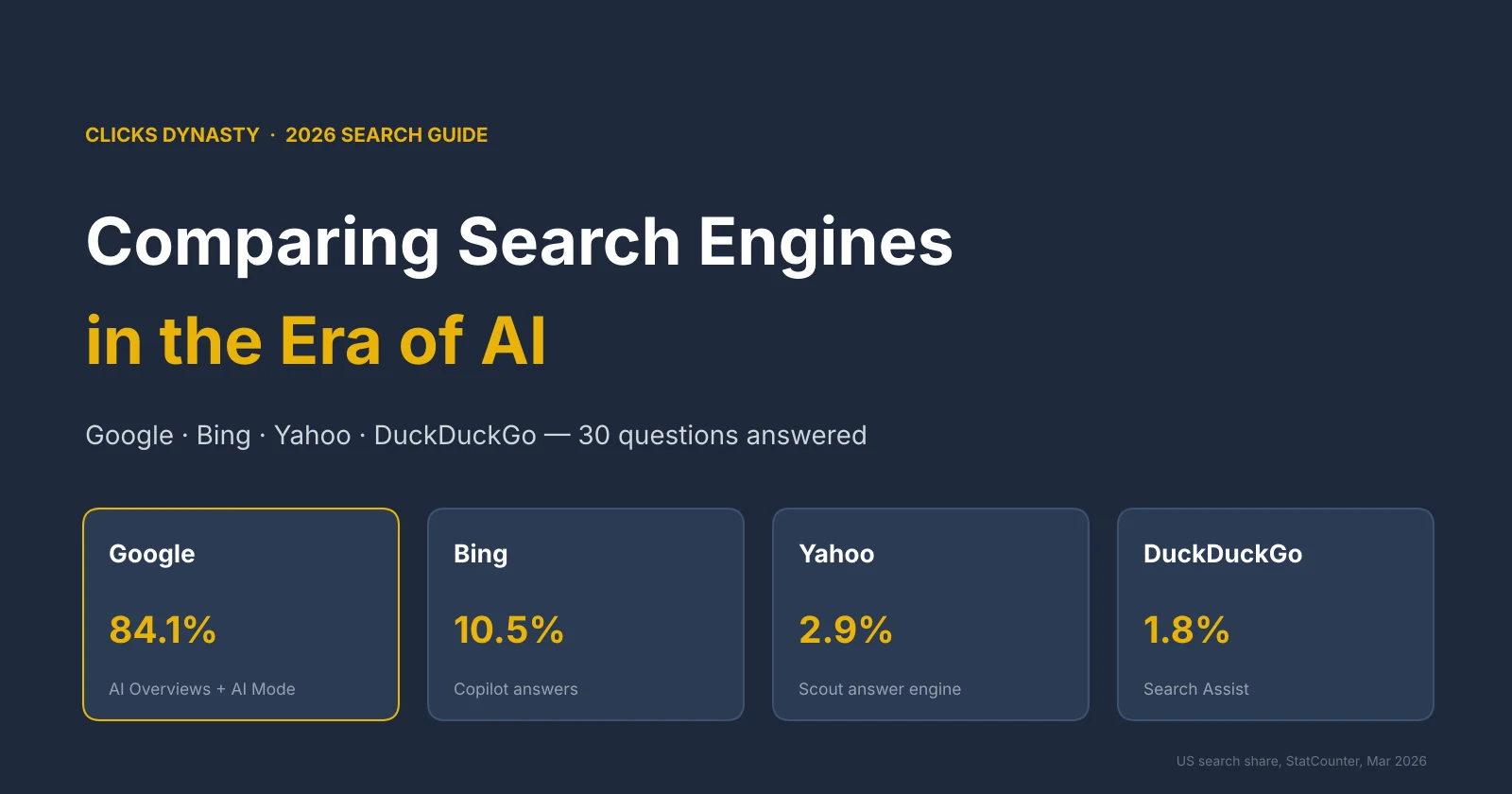
Executive summary: search didn't die, the click did
Every major search engine now answers the question before the searcher reaches your website. Google has AI Overviews and AI Mode, Bing has Copilot, Yahoo has Scout and DuckDuckGo has Search Assist. For a business, that changes the goal. Ranking first is no longer the finish line. Being named or cited inside the AI answer is.
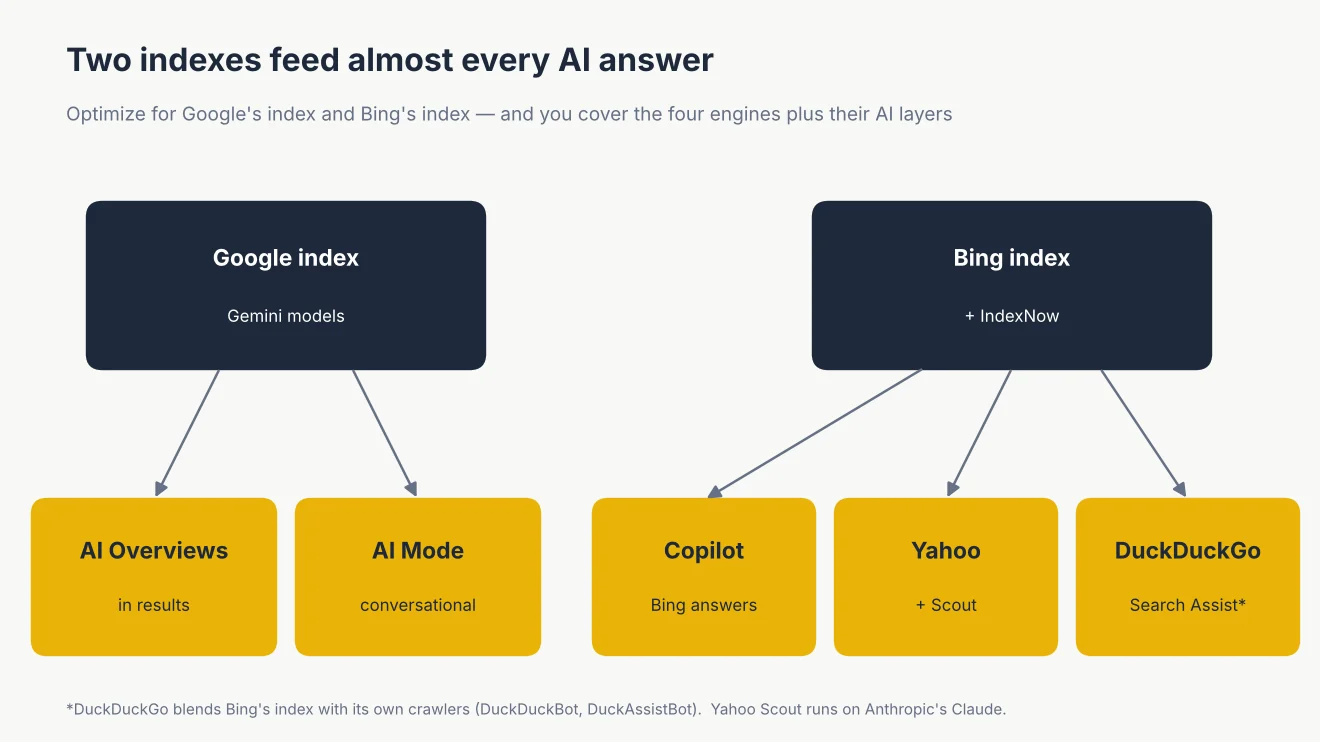
The good news: those AI answers are built from just two search indexes, Google's and Bing's. Optimize for both and you are visible on all four engines and their AI layers. Our own research shows why that matters locally: in the California AI Visibility Index, ChatGPT and Perplexity agreed on only 24% of local business recommendations, and our Bakersfield AI crawler study found 1 in 14 local websites blocking AI crawlers, making themselves invisible to AI answers.
This guide compares Google, Bing, Yahoo and DuckDuckGo side by side, then gives you a step-by-step roadmap, the KPIs to track and 30 straight answers. For the wider marketing picture, see our guide to digital marketing in the AI era.
Core pillars: the four search engines and their AI
| Bing | Yahoo | DuckDuckGo | ||
|---|---|---|---|---|
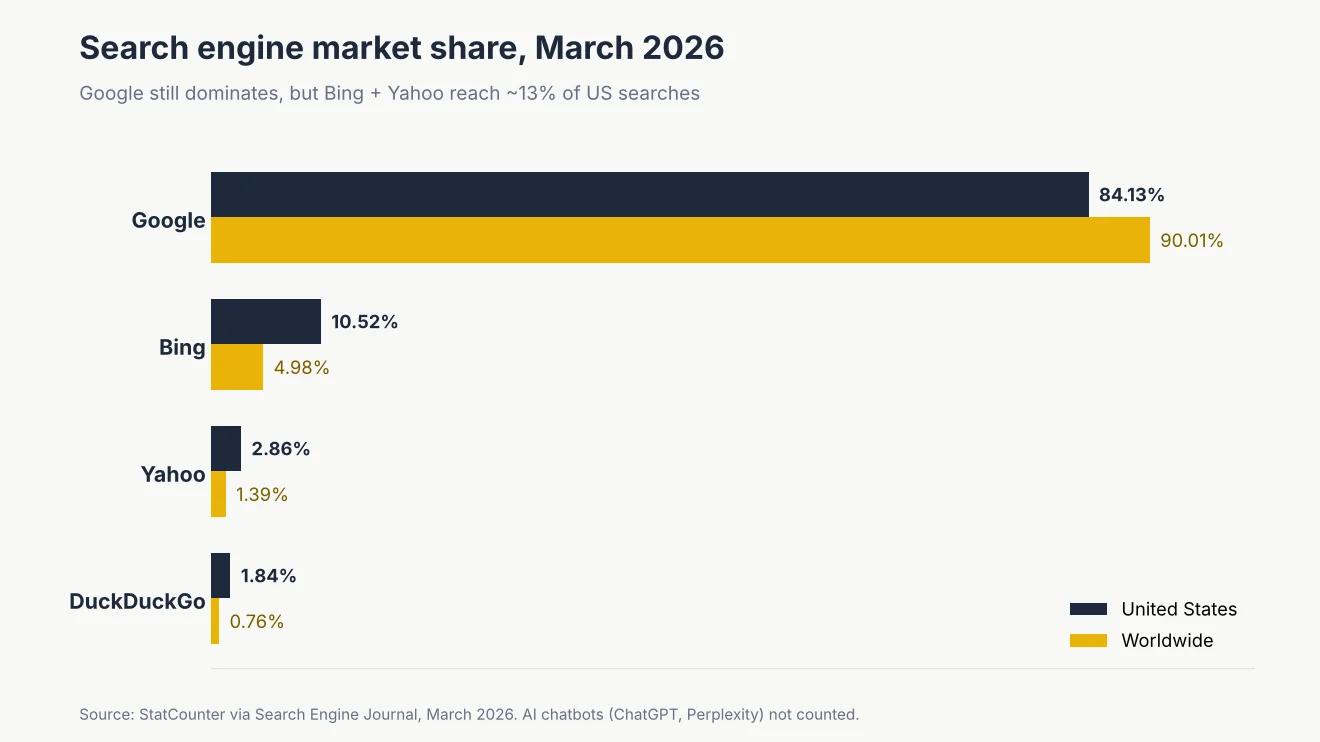
| US share (Mar 2026) | 84.13% | 10.52% | 2.86% | 1.84% |
| Global share | 90.01% | 4.98% | 1.39% | 0.76% |
| AI answer layer | AI Overviews + AI Mode | Copilot answers | Yahoo Scout | Search Assist + Duck.ai |
| AI reach | Overviews 2.5B+ monthly users; AI Mode 1B+ | Copilot in Bing, Edge and Windows | ~250M US users reachable | Optional; 20%+ of searches on “Often” |
| Results powered by | Google index | Bing index | Bing index | Bing + own crawlers |
| AI measurement | Search Console Generative AI report | Bing Webmaster Tools AI Performance | Through Bing Webmaster Tools | No dedicated report |
| Ads platform | Google Ads | Microsoft Ads | Microsoft Ads | Microsoft Ads |
| Best for | Reach, local, mobile | Desktop, B2B, AI citations | Finance and news audiences | Privacy-minded, tech-savvy users |
Google: biggest reach, biggest click squeeze
- AI Overviews show on roughly 20–25%+ of searches; AI Mode passed 1 billion monthly users in May 2026.
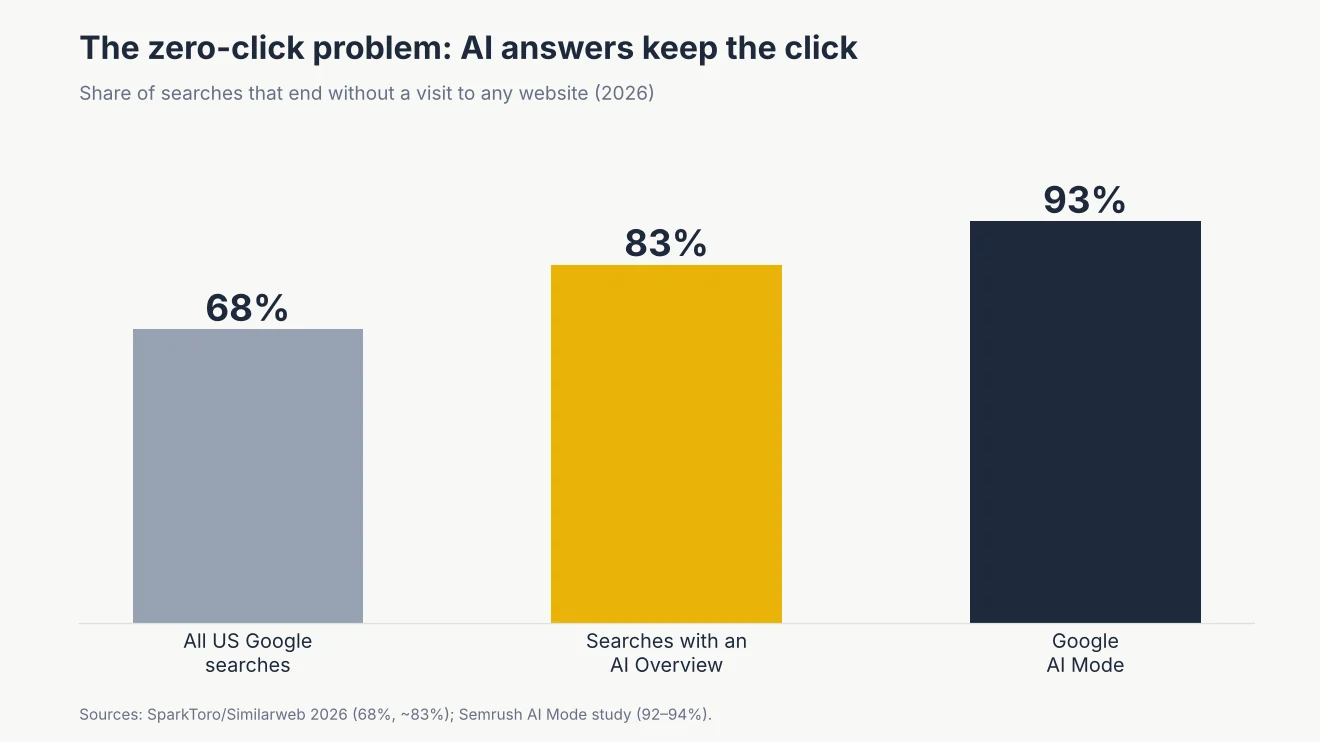
- Click-throughs fall hardest on informational queries. Branded, local and shopping searches are far less affected.
- Being cited still pays: cited brands saw 15.74% paid CTR vs 11.19% when not cited.
Bing: the hidden engine behind several AI assistants
- Record share (about 10% US), concentrated on desktop: ~10.5% of desktop search vs ~0.6% on mobile.
- Its index grounds Copilot, Yahoo and much of DuckDuckGo.
- The only engine that shows you exact AI citations, cited pages and Citation Share against competitors.
Yahoo: Bing results with a new AI front door
- No index of its own; results come from Bing.
- Yahoo Scout (beta, January 2026) runs on Anthropic's Claude and leans on Yahoo News, Finance and expert reviews.
DuckDuckGo: small, private, high-intent
- ~1.84% of US search; users choose how often AI answers appear.
- Search Assist cites one or two sources and uses a separate crawler, DuckAssistBot, which you can allow or block on its own.
Step-by-step execution roadmap
Foundation
- Verify your site in Google Search Console and Bing Webmaster Tools; submit your XML sitemap to both.
- Audit robots.txt: allow Googlebot, Bingbot, OAI-SearchBot, PerplexityBot and DuckAssistBot.
- Turn on IndexNow so Bing, and the engines it feeds, see changes in hours.
- Publish an
llms.txtfile that sums up your business, services and pricing.
Answer-ready content
- Put a 40–60 word direct answer under every question-style heading.
- Build comparison pages with real HTML tables, the format Copilot cites most.
- Add schema: Organization, LocalBusiness, FAQPage, Article and Review.
- Publish original data. AI engines favor facts they can't find anywhere else.
Off-site authority
- Make name, address and phone identical on Google Business Profile, Bing Places, Apple Business Connect, Yelp and Clutch.
- Ask real customers for reviews every month. Never buy or incentivize them.
- Pitch local press and the authors of “best of” lists, the sources AI answers quote.
Paid & measure
- Run Google Ads for reach and Microsoft Ads for Bing, Yahoo and DuckDuckGo desktop traffic.
- Each month, ask 5–10 buyer questions in Google AI Mode, ChatGPT, Perplexity and Copilot (logged out) and log who gets named.
- Review the KPIs below and shift budget toward what converts.
Key performance indicators (KPIs)
| KPI | Where to find it | Healthy target |
|---|---|---|
| AI impressions (Google) | Search Console → Generative AI | Growing month over month |
| Copilot citations | Bing Webmaster Tools → AI Performance | Growing; know your top 10 cited pages |
| Citation Share | Bing Webmaster Tools → Citation Share | Ahead of your top 3 competitors |
| AI share of voice | Monthly prompt log | Named in at least 1 of every 3 tracked prompts |
| AI referral sessions | GA4: chatgpt.com, perplexity.ai, copilot.microsoft.com, gemini.google.com | Up quarter over quarter (ChatGPT referrals grew 206% YoY industry-wide) |
| AI referral conversion rate | GA4 conversions by source | Equal to or above organic |
| Branded search volume | Search Console and Bing queries | Rising; AI mentions drive brand searches |
| Non-branded organic CTR | Search Console / Bing Webmaster Tools | Benchmark it; expect pressure on AI Overview queries |
| Bing + Yahoo + DuckDuckGo traffic | GA4 by source | Tracked separately, not lumped into “other” |
| Index coverage | Search Console Pages + Bing Site Explorer | 95%+ of key pages indexed in both |
| Review velocity | Google, Yelp, Clutch | 2–4 new genuine reviews a month |
Measurement note: clicks from Google AI Overviews land in GA4 as ordinary organic traffic. Pair the Search Console Generative AI report with landing-page data to estimate the real AI impact.
Pro tips and common pitfalls
3 fast wins
- Claim Bing Webmaster Tools today. Fifteen minutes gets you AI citation data for Bing, Copilot, Yahoo and part of DuckDuckGo. Most competitors still haven't done it.
- Turn one key service page into a comparison table. Tables are Copilot's most-cited format, and one strong page can earn most of your citations.
- Fix name, address and phone consistency. One mismatched listing makes AI engines unsure you are the same business.
3 mistakes to avoid
- Optimizing for Google only. You ignore about 13% of US searches (Bing + Yahoo) and the index behind Copilot and Yahoo Scout.
- Blocking AI crawlers by accident. Security plugins and CDN defaults can block AI bots. If they can't read you, they can't cite you.
- Judging success by traffic alone. With 68–93% of searches ending without a click, track citations, share of voice and conversions, not just sessions.
30 questions about search engines in the AI era
Big picture
1. Which search engine matters most in 2026?
2. Is Google losing market share?
3. Which search engine is gaining?
4. Do market-share numbers include ChatGPT or Perplexity?
5. How big is AI search compared with classic search?
6. What is the single biggest change for marketers?
7. What are Google AI Overviews?
8. What is Google AI Mode?
9. How much do AI Overviews reduce clicks?
10. Which queries are least affected by AI Overviews?
11. Is it worth being cited inside an AI Overview?
12. Can I measure my AI Overview visibility?
13. Is Google Ads still worth it with AI answers?
Bing
14. Why care about an engine with about 10% share?
15. Where is Bing strongest?
16. What is Copilot search?
17. Can I see when Copilot cites my site?
18. What kind of content does Copilot cite most?
19. Is Microsoft Advertising worth running?
Yahoo
20. Does Yahoo have its own search index?
21. What is Yahoo Scout?
22. Who still uses Yahoo search?
23. How do I show up on Yahoo in the AI era?
DuckDuckGo
24. Is DuckDuckGo worth optimizing for?
25. Does DuckDuckGo use AI?
26. How do I get cited by DuckDuckGo Search Assist?
Strategy
27. What is the difference between SEO, AEO and GEO?
28. What actually gets a business named by AI search?
29. Do all AI engines recommend the same businesses?
30. What is the one thing to do this month?
Want to know if AI recommends your business?
Clicks Dynasty tracks visibility across Google AI Mode, ChatGPT, Perplexity and Copilot every month for businesses in Bakersfield and across California. Run our free SEO & AI checker, see our AI SEO services, or get in touch for a full SEO audit.
Data sources & disclaimer
 Click the image to open it full size.